Tactacam vs Stealth Cam: App, Photo Quality and Data Plan Showdown
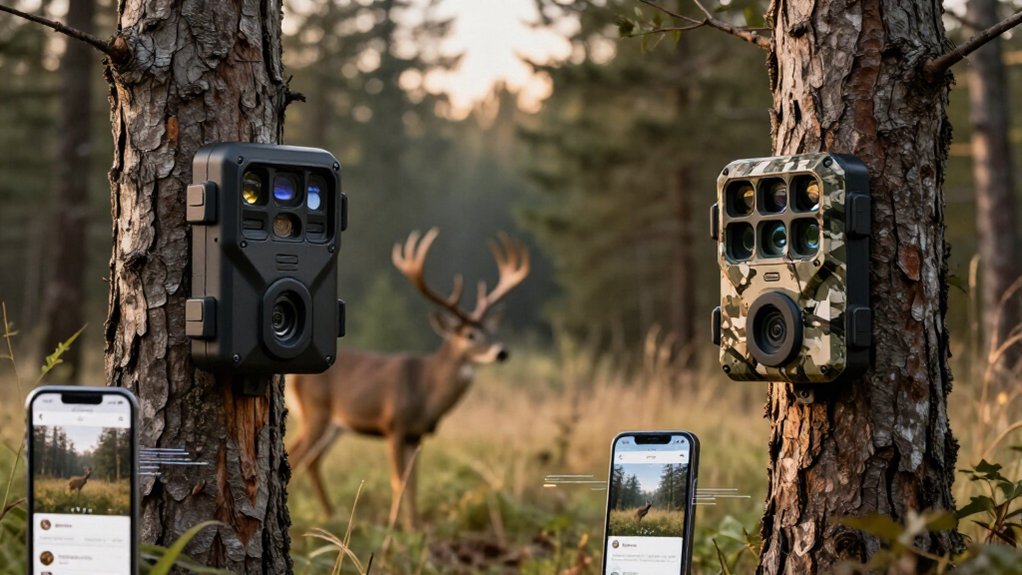
If you want sharper remote scouting, choose Tactacam REVEAL Pro 4.0 Solar: it delivers 4K/2.5K photos, integrated GPS, a monitor, and solar-backed power for $200.
Stealth Cam Revolver Pro 3.0 costs $130, uses 16 AAs, and trades resolution options up to 50MP for rotating 180- or 360-degree coverage. Both apps require activation and plans start at $5 monthly.
You’ll see how placement, signal checks, and mounting shape the better field setup in the sections ahead.
Tactacam Pro 4.0 Vs Revolver
The Tactacam REVEAL Pro 4.0 Solar and Stealth Cam Revolver Pro 3.0 target different trail-camera setups: Tactacam prioritizes image quality, remote features, and power efficiency, while the Revolver covers more ground from one mounting point.
At $200, your camera-and-battery package undercuts a separate $220 hardware purchase. Pro 4.0’s 4K/2.5K photos, live video, GPS, monitor, and 8GB storage suit scouting; add an SD card when needed. The $130 Revolver fires in 0.4 seconds and uses 16 AAs. Walkthrough tests caught both cameras at 10 and 60 feet day or night, but neither triggered at 110. Pro 4.0 reached 96 feet low-glow and 80 no-glow. Plans start at $5 monthly.
| Camera | Best use |
|---|---|
| Pro 4.0 | Detailed remote scouting |
| Revolver | Open fields and hardwoods |
| Plans | From $5/month |
Solar Panel vs Rotating Lens
For long deployments, Tactacam’s REVEAL Pro 4.0 Solar gives you a clear power advantage: the $200 package includes an R5 battery and solar panel, and testing produced more than a month of runtime with instant sends and several hundred photos per week.
That bundle costs less than buying camera and battery separately ($220), and lets you leave it longer without battery swaps. Fusion Max 3 accepts an optional lithium cartridge; it stayed full through a month of instant-send testing, though solar isn’t bundled. Choose Revolver Pro 3.0 for coverage: its rotating lens offers single-zone, 180-zone, or full 360-zone views, so you aren’t locked into one aim point. It uses 16 AA batteries; testing doesn’t establish solar support or direct runtime comparison in the field.
Trigger Speed and Detection Range
Battery life keeps a camera running, but trigger response and detection range determine what it actually records. In walkthrough testing, you’ll see similar baseline performance from the Tactacam REVEAL Pro 4.0: it reliably captured passes at 10 and 60 feet in daylight and darkness, yet missed movement at 110 feet.
The Stealth Cam Fusion Max 3 matched that result, recording 10- and 60-foot passes day or night but failing at 110 feet. The Revolver Pro 3.0, with its 0.4-second trigger, followed the same pattern. If you’re judging field coverage, target 0.5 seconds or faster and at least 90 feet. The Deceptor Max 3 stands apart: its advertised 0.3-second trigger captured multiple photos at 10, 60, and 110 feet either direction, with comparable nighttime results.
App Setup and Activation
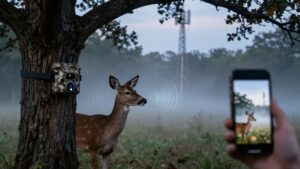
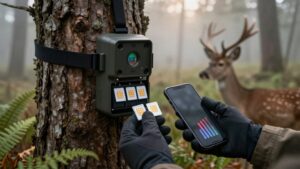
Getting either camera online starts in its companion app: you’ll activate a Tactacam REVEAL or Stealth Cam unit before selecting a data plan. That shared workflow means you’ll handle registration first, then move into plan selection once the camera is active.
REVEAL adds practical setup tools: built-in GPS lets the app help locate your camera, while certain models include a built-in monitor for checking placement in the field.
The Fusion Max 3’s app also uses GPS to locate cameras, but its post-setup organization runs deeper. You can filter images by species, separating whitetail does from bucks, and review photo data against moon phase, wind direction, and temperature.
Best Fit: Wide Food Plots
When you’re monitoring a wide food plot, the Stealth Cam Revolver Pro 3.0 fits better than a conventional forward-facing camera because its single-zone, 180-degree, and full 360-degree modes capture movement across the field without forcing you to pick one direction. That flexibility matters when deer enter from multiple edges or feed beyond a camera’s lane.
In walkthrough testing, it triggered at 10 and 60 feet day and night, but not at 110 feet. Mount it on a trail-camera stake rather than a tree, positioning coverage across the open area. You can select 4MP, 8MP, 16MP, or 50MP photos to balance detail and file size. At $130, with 16 AA batteries, it’s purpose-built for plots; a forward-facing Tactacam-style camera better suits tight travel corridors.
Five-Year Subscription Costs
Coverage mode matters in the field, but subscription cost shapes the long-term value. If you’re budgeting a five-season deployment, Tactacam REVEAL and Stealth Cam Revolver Pro 3.0 begin on equal ground: $5 monthly, or $300 across five years when pricing holds. Fusion Max 3 needs a different calculation because available pricing doesn’t specify its plan cost.
- Tactacam REVEAL: starts at $5 per month.
- Five-year baseline: $300 at an unchanged monthly rate.
- Revolver Pro 3.0: starts at $5 monthly, matching that baseline.
- Fusion Max 3: no supported five-year total is available.
Treat these as subscription-only estimates, not all-in ownership figures. Your actual spend can rise or fall with plan selection and future price changes.
For comparison, log required photo volume before committing. Keep costs visible.
Carrier Coverage and Signal Gaps
Carrier choice can make or break a cellular trail-camera setup. The protocol placed both cameras only where service was reasonable, so you can’t treat these results as a weak-coverage verdict. REVEAL Pro 4.0’s plan starts at $5 per month. Fusion Max 3 delivered photos reliably across a month-long field test. Its app’s GPS map helps you find deployed cameras, not diagnose reception. Before deployment, check coverage at each exact site and confirm which carrier works there. Don’t assume a nearby phone’s signal matches the camera location at all.
Mounting Bracket vs. Tree Strap
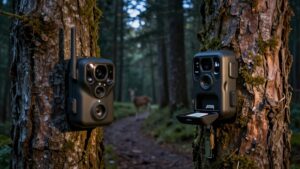
Tactacam’s REVEAL Pro 4.0 Solar gives you a two-axis tree mount, so you can fine-tune its aim after placement. If you run Stealth Cam’s 360-degree Revolver Pro 3.0, use a stake to preserve its all-direction capture.
Bracket Placement Flexibility
Where you mount a camera often matters as much as the sensor itself. Tactacam gives you a defined edge in post-attachment aiming: the REVEAL Pro 4.0’s two-axis tree mount lets you tune framing vertically and horizontally without relocating the camera. That’s useful when trails don’t line up cleanly with a trunk.
- You can correct tilt after mounting.
- You can shift left or right for trail angles.
- You should consider a stake for Revolver Pro 3.0 in fields or open hardwoods.
For bracket-placement flexibility, Tactacam has the clearest documented solution. Stealth Cam’s Revolver benefits from a stake where 360-degree coverage needs an unobstructed viewpoint. Keep vegetation out of your detection zone when aiming.
Tree Strap Setup Speed
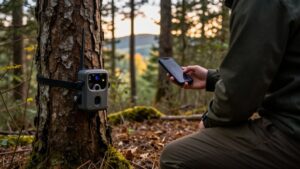
Mounting speed comes down less to a documented strap-time advantage and more to how easily you can finish your aim once the camera is on the tree. Tactacam’s REVEAL Pro 4.0’s included two-axis tree mount gives you a practical edge after attachment: you can fine-tune vertical and horizontal framing without restarting the install.
If you’re hanging multiple cameras, prioritize the setup that lets you secure the unit, verify coverage, and correct its aim quickly. A simple mounting workflow can reduce deployment friction.
Best for Public-Land Scouting
For public-land setups, you’ll want discreet mounting, dependable carrier coverage, and security that discourages theft. Tactacam’s aiming monitor and two-axis mount help you place the REVEAL Pro 4.0 Solar quickly in unfamiliar timber, while Stealth Cam’s lower-cost Fusion Max 3 makes multi-camera coverage easier. Both deliver field-tested detection to 60 feet day or night, so your choice comes down to concealment strategy, network fit, and how you secure each camera.
Discreet Mounting Options
A discreet public-land setup needs fast, low-profile placement, and Tactacam gives you the stronger tree-mounting option with the REVEAL Pro 4.0’s included two-axis mount, which lets you fine-tune the camera angle while keeping it tight to the trunk. That adjustment matters when you’re hiding it in irregular bark or aiming down a trail.
- Use the included mount for quick, close-to-tree alignment.
- Pair Stealth Cam’s Revolver Pro 3.0 with a stake when trees aren’t available.
- Use GPS tools to recover concealed cameras efficiently.
- Don’t assume either unit is physically less visible; no profile measurements settle it.
Tactacam wins the tree-first setup; Stealth Cam’s stake route adds flexibility on open ground. In either case, you’ll get better results by avoiding obvious angles and minimizing exposed hardware.
Cellular Coverage Flexibility
For public-land scouting, verify uploads before leaving: place either camera where service is reasonable and test the signal at each site.
Tactacam has documented built-in GPS on REVEAL Pro 4.0. Stealth Cam’s Fusion Max 3 app shows camera locations by GPS, which helps you manage dispersed sets. Automatic carrier selection could simplify moves between locations. Don’t assume either brand reaches farther in marginal cover; test every deployment and pick the system whose GPS workflow best fits your route and scouting style.
Theft Deterrence Features
Neither camera offers documented anti-theft locks, tamper alerts, or recovery tools, so GPS location tracking is your clearest safeguard on public land. That leaves you managing concealment and placement, not relying on a built-in security system. Tactacam’s REVEAL Pro 4.0’s built-in GPS can help you identify its location after it disappears. Stealth Cam’s Fusion Max 3 app also maps camera locations by GPS, helping you audit your spread.
- Mount the REVEAL Pro 4.0 with its two-axis tree mount for a tighter, better-hidden angle.
- Treat Fusion Max 3 location pins as inventory checks, not theft protection.
- Record each setup site, time, and camera ID before leaving.
- Choose discreet placement and revisit cameras promptly when GPS data shows a concern or gaps appear during your checks.
Pick Tactacam for GPS
Choose Tactacam if built-in GPS ranks high on your trail-camera checklist. The REVEAL Pro 4.0 integrates GPS directly into the camera and includes a two-axis tree mount, giving you a deployment package. In the field, that matters when you’re managing several sets across unfamiliar ground and need a way to pinpoint each unit.
Tactacam also scales the protection on higher-end models. The REVEAL Ultra offers active GPS with battery backup, which can improve your odds of recovering a camera that’s lost or stolen. Stealth Cam’s Fusion Max 3 app can display camera locations by GPS, but the details don’t confirm onboard GPS hardware. If location tracking must be part of the camera itself, rather than app mapping, Tactacam gives you the clearer, feature-rich option.
Conclusion
You’ll get dependable scouting from both brands, but Tactacam wins when you need faster app activation, stronger GPS tools, and simpler public-land deployment. Stealth Cam’s Revolver gives you flexible rotating-lens coverage, making it a smart fit for wide food plots. Check carrier maps before buying, since signal gaps can erase any camera’s advantage. If you value quick setup, solid photo delivery, and reliable tracking, pick Tactacam; if coverage angle matters most, choose Stealth Cam.