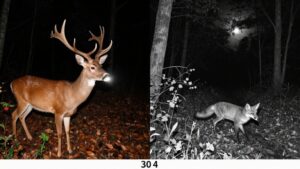
Can Deer See Infrared Trail Camera Flash? What the Science Says
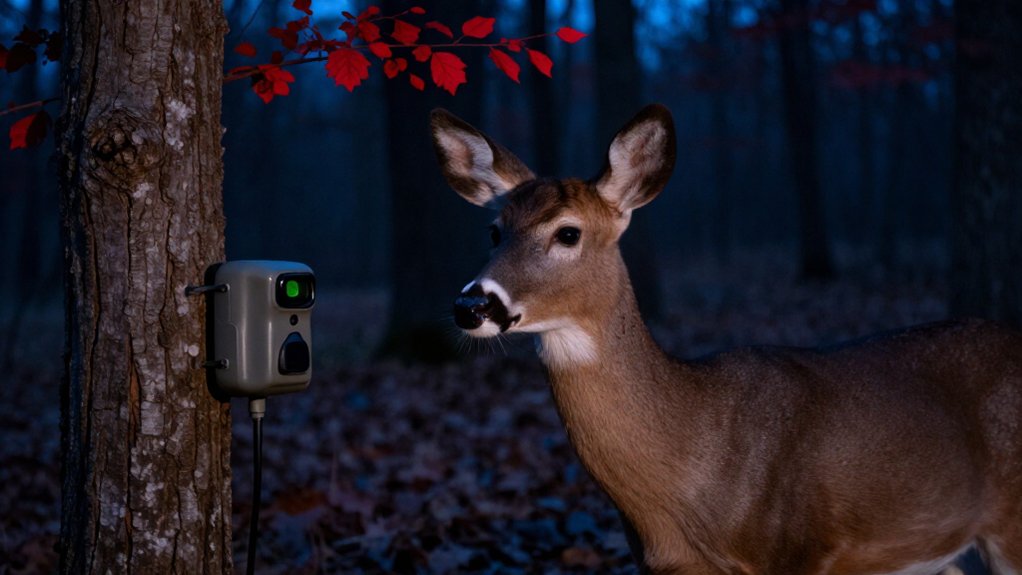
Deer can’t see true infrared wavelengths, but you shouldn’t assume an infrared trail camera is undetectable. An 850 nm camera may emit a faint red glow that deer can notice, while 940 nm no-glow models usually reduce visible light but produce dimmer images.
Deer may also detect clicks, reflections, human scent, or installation disturbance. A deer’s stare or route change doesn’t prove infrared caused it. These factors can help you choose a less detectable setup.
Deer Detect Faint Red Glow
Although deer have limited color vision, they may detect the faint red glow produced by low-glow infrared trail-camera LEDs. Visibility depends on LED intensity, emitted wavelength, camera distance, ambient light, and the deer’s angle of view. You shouldn’t equate poor red discrimination with complete inability to notice a dim red source. Instead, a deer may register the glow as a small light or contrast change without identifying its color.
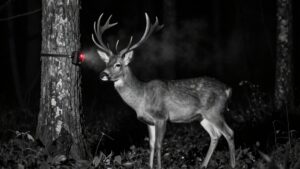
Night photographs showing deer staring toward infrared cameras support this possibility. A 2014 camera-trap study concluded many mammals may perceive infrared illumination, although responses varied among species. Detection doesn’t necessarily alter behavior: deer may ignore the glow, investigate it, or continue normally. However, reports include deer shifting movements in some settings when cameras are present.
Deer Lack Infrared Receptors
Deer lack retinal receptors that respond to true infrared wavelengths, so they can’t see infrared light beyond the human-visible spectrum. Your trail camera can record scenes under infrared illumination because its sensor detects wavelengths that a deer’s eyes don’t. Their dichromatic vision favors blue and ultraviolet. They distinguish red, orange, and yellow less effectively than humans, but reduced red sensitivity doesn’t create infrared perception. Infrared radiation remains outside their visual range.
This distinction matters when you interpret camera behavior. A deer cannot see the camera’s infrared output, yet it may detect a faint red glow from certain units. It may also notice movement or sounds or human scent near the device. Consequently, you shouldn’t assume that an animal’s response proves it saw infrared light.
Deer Reactions at Mineral Sites
At mineral sites, a deer’s response to a trail camera doesn’t necessarily mean it saw infrared illumination. Some deer stare toward cameras in nighttime images, whereas others shift travel 20 to 30 yards or stop using the site. These observations can suggest that deer detected a faint red emitter, but they don’t establish detection: intensity, wavelength, and camera distance can influence any response.
Human scent, installation activity, and repeated equipment checks also disturb deer and may explain reduced use. If activity declines after deployment, place the camera higher or conceal it more effectively, minimize visits, and compare subsequent images with pre-installation records. No-glow infrared cameras use illumination invisible to people and are designed to lower the likelihood of alerting deer, although behavior alone can’t identify causation.
850nm Versus 940nm LEDs
When you compare trail-camera LEDs, 850 nm units can produce a faint red glow, whereas 940 nm units are generally no-glow to people. Deer likely do not see either wavelength as color, but individual sensitivity, distance, and ambient conditions may affect detection. You typically gain brighter, longer-range images with 850 nm illumination, while 940 nm reduces visible glow at some cost to image brightness.
Wavelength And Visible Glow
Wavelength largely determines whether a trail camera’s infrared flash produces a visible glow: 850 nm LEDs can emit a faint red light that deer may notice under some conditions, while 940 nm LEDs operate at a longer near-infrared wavelength and typically appear “no-glow” to people. Both are near-infrared, beyond human visible-light limits, but a camera sensor records their reflected illumination in darkness. When you choose 850 nm, the wavelength sits closer to visible red; high-output LEDs can consequently create a dim source glow.
At 940 nm, that glow is generally absent to you, which supports more discreet placement. Still, “no-glow” describes human appearance, not universal invisibility. Output intensity, distance, and ambient conditions affect whether the red emission from an 850 nm unit is noticeable.
Deer Sensitivity Differences
Deer’s visual system favors blue and ultraviolet wavelengths and distinguishes red, orange, and yellow less effectively, which may reduce their sensitivity to the faint red glow produced by 850 nm infrared LEDs. When you compare 850-nm and 940-nm LEDs, wavelength is only one factor in detectability. Near-infrared light at 940 nm lies beyond human vision and is generally considered less detectable to deer than shorter-wavelength infrared.
No-glow cameras commonly use low-intensity illumination and/or 940-nm emitters, so you may reduce the chance that a deer notices the flash. Yet detection can vary with brightness, distance, and environmental conditions. Evidence on deer’s infrared perception remains limited, so you shouldn’t treat 940 nm as proof that deer cannot detect any camera. Results can differ across field settings.
Range And Image Tradeoffs
Although both 850 nm and 940 nm LEDs illuminate scenes with infrared light, they make different range and image-quality tradeoffs. You’ll usually get brighter, more detailed nighttime images with 850 nm illumination, especially at longer distances. However, its low-glow LEDs can emit a faint red glow. A 940 nm no-glow unit better minimizes visible glow, but it generally yields darker, less detailed images when other settings match. Neither label proves what a deer detects under every condition; intensity, distance, and ambient conditions also matter.
| Option | Strength | Limitation |
|---|---|---|
| 850 nm | Brighter images | Faint red glow |
| 940 nm | Less visible glow | Darker images |
| Selection | Match choice to | your monitoring priority |
Choose 850 nm for image brightness, or choose 940 nm when you prioritize concealment in field.
Distance Alters Visible Glow
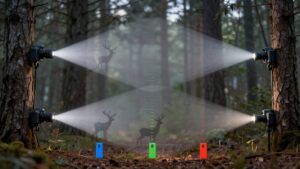
At close range, you may see a dim red glow from an 850nm low-glow camera, which deer may also detect. At midrange, detection likely depends on LED intensity, wavelength, and ambient conditions. As distance increases, the glow’s apparent brightness declines, although no evidence identifies a precise detection threshold for deer.
Near-Range LED Visibility
Low-glow trail-camera LEDs can emit a faint red glow that deer may detect at close range, even when the illumination appears invisible to you. At short distances, the LED source occupies a larger visual angle and delivers more light to the animal’s eyes, increasing the chance that any residual visible emission stands out. Detectability varies with the diode’s output, its wavelength, and your camera’s placement relative to the deer. Infrared radiation itself lies beyond human vision, but a camera can also leak a small amount of deep-red light near the visible boundary. No-glow models generally reduce this risk by using lower-intensity emitters and/or longer wavelengths. If a deer notices the glow, however, that observation doesn’t establish alarm or avoidance; deer may not react.
Midrange Glow Detection
Distance changes how readily a deer can detect the faint red component of a low-glow infrared flash. At midrange positions, detection depends on the LEDs’ output, emitted wavelength, viewing angle, and ambient light.
A camera whose illuminators produce a stronger visible-red spill gives the deer more opportunity to register the source; lower-output units usually present a subtler cue. You shouldn’t treat a visible glow as proof of disturbance. A deer can perceive the flash without altering its gait, feeding, or vigilance in any obvious way.
Individual reactions also vary with behavior and setting. Field observations report differing responses among infrared, low-glow, black-flash, and white-flash cameras, so camera type alone doesn’t predict how a particular deer will respond during a single encounter at a site.
Distance Reduces Perception
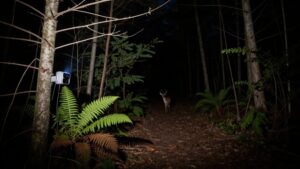
As a deer moves farther from a low-glow trail camera, the dim red light from its infrared LEDs becomes harder to perceive. When you place the camera farther from a travel route, reduced apparent brightness can make the glow less likely to attract attention. However, distance doesn’t make low-glow illumination inherently invisible; intensity, wavelength, ambient conditions, and the deer’s visual sensitivity still matter.
| Camera placement | Evidence-based implication |
|---|---|
| Nearer deer | Red glow may be more noticeable. |
| Farther deer | Dim glow is less likely noticed. |
| No-glow LEDs | Detection is less likely than low-glow. |
You shouldn’t assume a fixed invisible distance, because available evidence doesn’t establish one. Test placement at your site, but recognize that deer may still detect a visible red glow under favorable viewing conditions.
Aim Cameras Across Trails
Aim the camera across a deer trail rather than directly down it. This orientation increases the likelihood that a deer will cross the sensor’s detection zone and trigger an image. It also keeps a moving animal within the frame longer, which can offset slower trigger speeds.
Select a natural funnel, such as a route between water sources or alongside a fence, where travel is concentrated. Position the unit to cover that route while minimizing its visible, boxlike profile; deer may detect the camera visually even without a flash.
Once installed, leave it in place and reduce visits. Repeated adjustments and human scent can alter deer movement patterns and lower capture rates. Use natural cover to conceal the housing without blocking the lens or sensor.
Camera Clicks Can Spook
Placement reduces visual exposure, but a trail camera can still alert deer through sound. Even cameras without a visible flash may produce operational noise when they activate. Filter mechanisms, shutters, or other internal components can click, creating a cue that deer may notice near a trail.
A 2014 study indicated that many mammals can detect camera-trap sounds, including frequencies in infrasound and ultrasound ranges. This evidence doesn’t prove every deer will react, because sensitivity and context vary, but it supports treating noise as a potential disturbance. Choose a model engineered for quiet operation, then test it before deployment by triggering it at close range. Once installed, leave it in place and limit checks. Repeated moves and tests add disturbance and may increase deer attention.
Ignoring Wind During Setup
Wind direction can determine whether deer encounter your scent while you install or service a trail camera. Deer detect potential threats through sight, sound, and odor, so air movement can carry your scent toward animals using the area. In heavily pressured habitats, deer may respond especially cautiously to unfamiliar human odor. Reduce this avoidable variable during each visit:
- Check wind before approaching the site.
- Handle the camera and mount with clean hands.
- Avoid unnecessary repositioning or routine checks.
- Leave a well-placed camera operating longer.
- Use cellular transmission to reduce site visits.
If deer become wary or detections decline, evaluate wind, location, and service habits before attributing the change solely to infrared flash. This approach limits disturbance and supports more representative observations of deer activity.
Check Lens Reflections at Night
At night, review your images for bright lens or infrared-filter reflections that could make the camera conspicuous to deer and other wildlife.
Inspect frames from multiple nights at varying distances. A persistent bright spot, lens sheen, or LED glow indicates that the camera may be detectable. Infrared LEDs can emit a faint red glow, and cameras with infrared filters may produce a click at activation. A 2014 camera-trap study suggested that many mammals may perceive infrared illumination; as a result, infrared doesn’t necessarily mean invisible to wildlife.
If you find a reflection or glow, adjust the camera’s angle or location and retest in practice. If it remains conspicuous, use a no-glow model. It produces illumination designed to be invisible to human eyes and potentially less detectable to animals.
Conclusion
Evidence indicates deer don’t detect infrared light itself because their retinas lack infrared-sensitive receptors, but you may still see responses to faint red 850 nm LED glow, camera clicks, reflections, or human scent. You’ll reduce disturbance by using 940 nm units, placing cameras farther from travel routes, aiming across trails, minimizing setup time, and checking equipment after dark. At mineral sites, interpret avoidance cautiously: wind, noise, distance, and prior exposure can all influence observed behavior.