Spypoint vs Tactacam: Image Quality, Plans and Reliability Compared
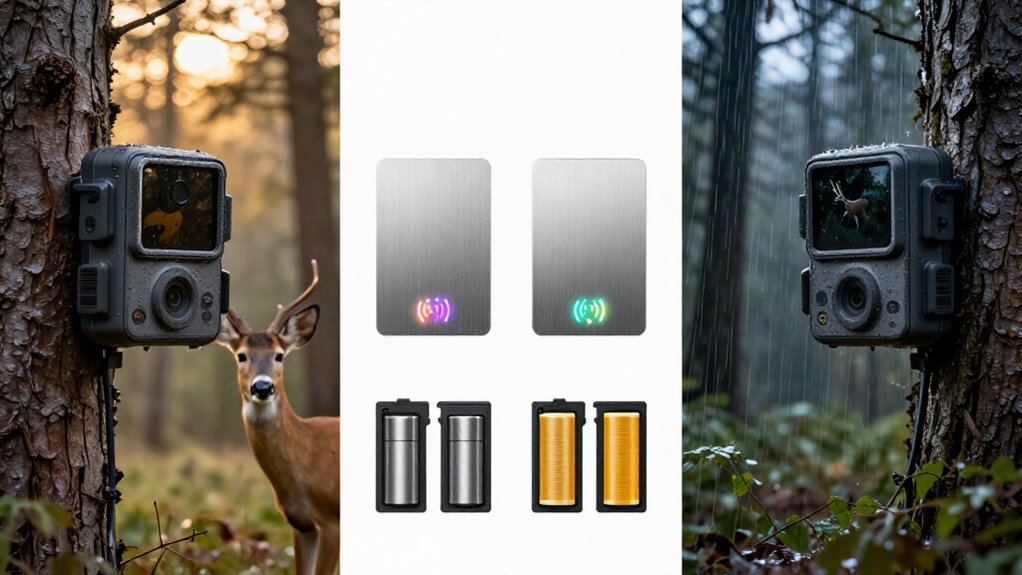
Choose Tactacam if you need sharper day and night photos, faster triggering, and value at high image volumes. Reveal X PRO outperformed the tested Spypoint Flex G-36 for distant identification, while the lower-cost Gen 2.0 delivered similar image quality but lacks GPS.
Tactacam unlimited costs $120 annually; Spypoint includes 100 free photos monthly. You should verify SIM provisioning, carrier signal, and cold-weather battery life at your site. The details below clarify setup, placement, and costs.
Carrier Network Availability
Tactacam Reveal cameras rely on SIM cards for cellular connectivity. You should verify network compatibility before deployment. Field reports show mixed SIM provisioning outcomes rather than a confirmed carrier matrix.
| Model | SIM observation | Network implication |
|---|---|---|
| Reveal X PRO | Two SIMs included | Verizon card initially unrecognized |
| Support resolution | Manual card addition | Verizon provisioning corrected |
| Reveal X Gen 2.0 | No SIM included | Unit returned; $4.67 refunded |
| Replacement Gen 2.0 | SIM included | Wi-Fi setup eventually completed |
Compared with a clearly published carrier list, this evidence leaves you dependent on device-specific SIM inclusion and support intervention. Confirm the supplied SIM, recognition status, and coverage options before committing to a camera.
Cellular Photo Delivery Workflow
Once a camera connects to a carrier, its photo-delivery workflow determines both ongoing cost and setup friction. Spypoint gives you 100 monthly photos free, while its unlimited delivery plan costs $120 annually. Tactacam offers 250 images for $5 per month or unlimited delivery for $13; annual billing reduces those prices to $4.58 monthly and $120 yearly, respectively.
- Spypoint suits you if a free allocation covers routine monitoring.
- Tactacam provides a lower entry price for modest paid volume.
- You may find Tactacam’s app usable, but Wi-Fi setup on Reveal X Gen 2.0 non-intuitive and slow.
- A Reveal X PRO Verizon SIM required manual activation, and Wi-Fi searching may have cut AA battery from 100% to 80% within an hour.
Compare setup and plans before buying.
Trigger Speed and Range
Trigger performance varies more by model than by brand in the available comparison.
Within Tactacam’s tested models, the Reveal X PRO triggered faster than the Reveal X Gen 2.0. That result indicates a model-level advantage when you need to capture animals moving through a detection zone. The X PRO’s triggering range also exceeded its advertised specification in the review. For Spypoint, the Flex G-36 produced false triggers. You should consequently treat its trigger performance as unquantified, rather than assume it trails or matches Reveal models.
App Setup and Activation Steps
App setup created more friction for Tactacam’s Reveal models than a straightforward activation process should. You need Wi-Fi to activate the Reveal X Gen 2.0, but its workflow can feel non-intuitive and slow.
- One Gen 2.0 arrived without a SIM and required return; Tactacam immediately refunded the $4.67 activation fee.
- Its replacement included a SIM and eventually activated over Wi-Fi.
- During setup, AA charge fell from 100% to 80% within an hour, potentially because it kept searching for Wi-Fi.
- The Reveal X PRO included two SIMs, yet its Verizon card was unrecognized until support manually added it after you called.
These outcomes indicate that hardware provisioning and network registration can add steps beyond normal app pairing, making activation less predictable for you in practice.
Best for Remote Hunting Leases
For a remote hunting lease, the Tactacam Reveal X PRO is the better fit because it produced stronger day and night images and triggered faster than the Reveal X Gen 2.0. You get more usable identification detail when game passes through mixed light, while the faster response improves the odds of recording animals before they leave the detection zone.
Its trigger range also exceeded the advertised specification, giving you broader coverage along trails, field edges, or distant access routes. On a large lease, the PRO’s GPS helps you locate a camera without searching every stand site. The no-glow flash further reduces visible nighttime disturbance, which suits pressured game and discreet placement. Compared with the Reveal X Gen 2.0, these advantages make remote monitoring more dependable.
Battery Replacement and Subscription Costs
Battery service and data-plan pricing can outweigh a camera’s purchase price over a full season. If you run a Reveal X PRO, estimated 3.6-month service intervals let you schedule swaps instead of reacting to downtime. Rechargeable lithium packs simplify replacement and can undercut disposable cells: a 20-pack of lithium AAs costs about $52.
- Tactacam unlimited-image service costs $13 monthly or $120 annually.
- Its 250-image Starter tier costs $5 monthly, or $4.58 monthly when billed annually.
- Spypoint’s free plan supplies 100 images monthly; unlimited costs $120 yearly.
- Four Tactacam unlimited plans total $480 annually, versus $719.52 for four Bushnell Cellucore 20 cameras.
You should match plan capacity to expected traffic and calculate battery replacements alongside annual service fees before deploying multiple units on your property.
Below-Freezing Battery Performance
Cold weather can shorten service intervals. The Reveal X PRO’s estimated 3.6-month battery life provides only a general benchmark because testing didn’t occur in cold conditions.
In the review, a rechargeable lithium power bank extended operating time versus AA alkaline batteries, while disposable lithium AAs were another option at roughly $52 per 20-pack. For the Reveal X Gen 2.0, alkaline charge fell from 100% to 80% during one hour of setup, possibly from continuous Wi-Fi searching. That result doesn’t isolate temperature effects. If you deploy cameras below freezing, verify battery chemistry, power draw, and service intervals at your site.
40MP Resolution Trade-Offs
You can’t use a 40MP claim alone to predict better trail-camera photos. Higher resolution can preserve more detail but also creates larger files, increasing storage and transmission demands. In low light, sensor performance and image processing can matter more than megapixels; testing favored the Reveal X PRO’s photos, while the Flex G-36 showed weaker image quality.
Detail Versus File Size
- Reveal X PRO’s unlimited plan: $13 monthly or $120 annually.
- Flex G-36’s free plan includes 100 pictures each month.
When choosing between them, treat visible quality and allowances as separate measures. Confirm detail retention through downloads, stated megapixels, and average file sizes.
Low-Light Performance Limits
Low-light results favor the Tactacam Reveal X PRO: the review found it produced better nighttime photos than the Spypoint Flex G-36, whose image quality was rated poor from a single-camera sample. You should treat that result as a qualitative comparison, not a megapixel-resolution test. Still, the X PRO delivered stronger usable images in day and night testing.
The X PRO uses no-glow infrared, while the Gen 2.0 uses a glow-type flash with different visibility and range. Yet the reviewer saw no perceived performance difference between them. If nighttime quality guides your purchase, the evidence favors Tactacam, but Spypoint needs broader testing.
Food Plot Camera Choice
For food-plot coverage, you’ll get a stronger result from the Tactacam Reveal X PRO, whose fast trigger and extended effective range help capture animals crossing open ground. Its superior day and night image quality should retain more useful detail at distance than the Spypoint Flex G-36. For frequent monitoring, compare Tactacam’s $5/250-image and $13 unlimited monthly plans against your expected image volume.
Coverage and Placement
Choose the camera that delivers dependable cellular service at your specific food plot. Test service at the exact mounting location before you commit. Tactacam’s Reveal X PRO adds GPS, so you can identify its location while managing several plots; the Reveal X Gen 2.0 doesn’t include GPS.
- Confirm the included SIM activates before mounting; one PRO Verizon SIM required customer-service assistance.
- Check Gen 2.0 package contents during setup; an initial unit arrived without a SIM.
- Verify signal where you expect the camera to transmit, not only at the plot entrance.
- Compare usable service after activation.
Image Detail at Distance
When you need to identify deer across a food plot, the Tactacam Reveal X PRO delivers sharper daytime and nighttime images than the Spypoint Flex G-36 in this comparison.
That advantage matters when you’re judging antlers or identifying marks at the far edge of your coverage area. The PRO also triggered faster than the Reveal X Gen 2.0 in testing, so you’re likely to record deer before it exits the frame. However, the Gen 2.0 produced virtually the same image quality as the PRO, despite its lower price and different feature set. The Flex G-36’s image quality rated poorly in this review, but that conclusion came from only one camera sample.
For food plots requiring distant identification, choose either Tactacam model over the Spypoint.
Plan Value for Monitoring
Image quality matters only if your plan supports the volume of food-plot activity you need to monitor. Tactacam Reveal’s Starter plan gives you 250 images for $5 monthly, or $4.58 monthly when billed annually. For consistently active plots, Pro’s unlimited tier costs $13 monthly or $120 annually, keeping usage costs predictable.
- Four Reveal cameras on annual unlimited cost $480 yearly.
- Four Bushnell Cellucore 20s cost $719.52 yearly on their plan.
- Spypoint’s Flex G-36 includes 100 free pictures monthly.
- Its unlimited plan costs $120 annually, but poor image quality and false triggers reduce the practical value of that allowance.
If you need dependable counts rather than a low entry price, Reveal’s unlimited plan offers clearer food-plot monitoring value during sustained, high-activity monitoring across cameras.
Warranty Coverage and Support
Tactacam’s documented support experience is mixed but specific. When a Reveal X Gen 2.0 failed to recognize a Verizon SIM card, support manually added the card after the customer called. A separate unit arrived without its SIM card, required return, and received an immediate refund of the $4.67 activation fee. These actions suggest support can resolve defined provisioning issues, but they don’t establish broader warranty performance. Without equivalent Spypoint cases, support quality remains unranked.
Conclusion
Your choice between SPYPOINT and Tactacam should follow your carrier coverage, monitoring distance, and power demands. You’ll likely prefer Tactacam when you need dependable app workflows, fast image delivery, and stronger cold-weather performance, provided its network serves your lease. SPYPOINT can suit you if you prioritize lower entry costs, flexible plan options, and straightforward food-plot monitoring. Compare local signal, monthly transmission needs, resolution settings, warranty terms, and support responsiveness before you deploy cameras in season.