Lithium vs Alkaline Batteries for Trail Cameras: Which Lasts Longer for the Money?
You’ll usually get more reliable photos per dollar from lithium AAs when your trail camera faces cold, heavy infrared use, or long unattended deployments. Lithium cells hold about 1.6 V, sustain IR-flash surges better, and work near −40°F; alkalines can lose up to half their capacity when freezing and sag below cutoff.
Alkalines may cost less upfront in mild conditions, but leakage and replacement visits add risk. Use matched, manufacturer-approved cells; comparisons ahead quantify tradeoffs.
Lithium’s 20-Year Shelf Life
That still exceeds dormant intervals common between deployments and can reduce replacement needs.
| Metric | Supported data |
|---|---|
| Shelf-life claim | Up to 10 years |
| Operating range | −40°F to 140°F |
Before you buy, compare each pack’s printed manufacture date, expiration date, and storage instructions. Manufacturers, not generic claims, set the applicable limit. You also get broad environmental coverage: reported operation spans −40°F to 140°F (−40°C to 60°C). For cameras left through winter or summer, that range provides a measurable advantage when conditions vary by location seasonally.
Nominal Voltage and Discharge Curves
Voltage behavior—not just rated capacity—determines how long a trail camera can run reliably. Alkaline AA cells start near 1.5–1.6 V, but their voltage declines steadily, often reaching about 1.2 V after roughly 20%–50% of discharge. Lithium AAs deliver about 1.6 V and hold near that level through most of their usable life, then fall sharply near depletion.
Your camera’s low-voltage cutoff sets the practical capacity it can access. Once alkalines dip below that threshold, they may retain energy you can’t use. Under an infrared-flash current pulse, voltage sag can briefly cross the cutoff and interrupt capture. Rechargeable 1.5-V lithium-ion AAs regulate output until abrupt shutdown, so voltage won’t reliably reveal remaining charge. Instead, use a meter that estimates remaining capacity rather than voltage alone.
Cold-Weather Runtime at -20°F
At −20°F, battery chemistry becomes a primary runtime limit: lithium AA cells remain usable to roughly −40°F, while alkaline cells can lose up to half their capacity in freezing conditions. For your trail camera, that difference changes usable, not merely rated, runtime. Alkalines experience cold-driven voltage sag, so your camera may shut down when infrared illumination or other peak loads demand current, even though capacity remains chemically stored.
Lithium cells hold adequate voltage across more of their discharge curve, allowing your camera to operate nighttime infrared flashes more reliably in severe cold. You can’t infer an exact -20°F runtime multiplier from these figures alone, because camera draw, trigger frequency, and flash use vary. Still, for extended winter deployment, lithiums reduce cold-related outages and require fewer replacements than alkalines.
Swap-and-Go Battery Changes
For quick trail-camera battery changes, single-use lithium AAs provide the most reliable swap-and-go option: they need no charging and typically run longer than alkalines, particularly in cold conditions. That runtime advantage can reduce site visits, helping offset lithium’s higher per-set price when your camera is distant or captures heavy activity. Lithium voltage stays useful for most of its service life, but it can fall sharply near depletion. Carry a sealed fresh set and replace all cells promptly if operation becomes unreliable.
Alkalines cost less and are easy to find, yet their gradual voltage decline can trigger shutdown before you use all remaining capacity. Don’t mix old and new cells: install a complete matched set. Check status more often in freezing weather and heavy use.
Manufacturer-Approved Battery Types
Before changing battery chemistry, check your trail camera’s manual or confirm compatibility with the manufacturer, because its input-voltage range and low-battery shutoff logic determine what it can use reliably. That check matters: four AA cells nominally supply 6 V, whereas NiMH cells supply 1.2 V each, or 4.8 V, and may trigger an early cutoff. A chemistry’s label doesn’t guarantee electrical compatibility; regulated voltage behavior and firmware thresholds govern field reliability under varying load and temperature.
- Use fresh, high-quality alkaline AAs when your model specifies them.
- Don’t mix old and new cells; imbalance reduces dependable operation.
- Confirm regulated 1.5 V rechargeable lithium-ion AA approval.
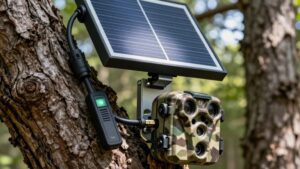
- Select only approved solar kits or external 12 V battery boxes.
- Match the documented voltage range, not chemistry labels alone.
Price Per 1,000 Photos
Price per 1,000 photos gives you a more useful battery-value metric than pack price because it accounts for usable output, not just upfront cost. Calculate it as battery cost ÷ usable photos × 1,000, while holding camera model, photo volume, and day/night mix constant. For the Browning Defender Pro Scout Max HD, Energizer Ultimate Lithium AAs at $3 each produce an estimated three-year battery expense of $144.
Divide $144 by estimated three-year photo total, then multiply by 1,000. The Tactacam Reveal Pro 3.0’s estimated lithium expense is $648 over three years; its rate changes with photo count. You can’t claim a direct lithium-versus-alkaline winner without alkaline price and usable-photo data. Alkalines may yield fewer usable photos when voltage cutoff strands capacity, raising their rate.
Lithium Passivation After Storage
Stored lithium AAs can show a temporary performance dip that price-per-photo calculations don’t capture. During storage, a thin passivation layer can raise internal resistance, briefly pulling voltage down under heavy load. Your camera may reveal it when infrared illumination switches on, although the cells retain substantial capacity. Unlike an alkaline comparison, this startup behavior can distort a one-time field check without proving lower total runtime.
- Test long-stored lithium AAs in your camera before remote deployment.
- Trigger infrared illumination during the test to impose a high demand.
- Expect performance to improve after the cells deliver current.
- Compare initial response separately from sustained photo capacity in your deployment planning and buying decision process.
Leak Risk in Stored Cameras
If you store your trail camera with alkaline cells installed, leakage can damage the battery compartment during extended inactivity. Remove alkaline batteries before storage, then inspect and clean the compartment per the manufacturer’s instructions before reuse.
Alkaline Leakage During Storage
Alkaline cells can leak while a trail camera sits unused, and the resulting electrolyte residue may corrode battery contacts or damage the compartment. That failure can turn a low-cost battery choice into an expensive camera repair, especially when you store the unit for months. Storage discipline matters because leakage may develop without any hunting use.
- Remove alkaline batteries before extended storage; leave the compartment empty and dry.
- Inspect stored cameras and batteries periodically for residue or corrosion around cells and terminals.
- Don’t mix old and new batteries; differences in charge and condition increase battery-problem risk.
- Compare replacement cost with camera exposure: a leaking set can create damage beyond battery expense.
- Follow manufacturer storage guidance for every battery type, and inspect stored sets before installation.
Lithium’s Lower Leak Risk
Single-use lithium batteries present a lower leakage risk than alkaline cells, so they’re the safer option when your trail camera may sit unused between seasons. Unlike alkalines, which can release corrosive material and attack contacts, lithium cells reduce the probability of storage-related compartment damage. That advantage matters if you deploy cameras briefly, then leave them idle for months.
Still, lower risk doesn’t mean zero risk. Remove all batteries before long-term storage, particularly alkaline cells, because any failed battery can contaminate contacts or the compartment. Inspect stored cameras and loose cells periodically.
Replace batteries showing corrosion, swelling, cracked casings, or other damage. This routine protects your camera and avoids the higher repair exposure associated with leaked alkaline electrolyte before your next deployment in the field.
Infrared Flash Power Draw
At night, your trail camera’s infrared LEDs can demand up to 1,000 mA in an instant, accelerating battery drain with every flash. Alkaline cells may sag below the camera’s cutoff voltage under this load, causing dark footage, recording failures, or shutdowns despite remaining charge. Lithium batteries typically sustain flash current more reliably, especially in cold conditions, but you should confirm your camera’s battery compatibility guidance.
Infrared Flash Energy Demand
Nighttime imaging creates the trail camera’s highest short-duration load: its infrared LEDs can demand a substantial current surge, with some no-glow models drawing up to 1,000 mA during a flash.
That pulse tests battery voltage more than average consumption. You need cells that deliver peak current without crossing the camera’s operating threshold. Alkalines become less reliable as they discharge, so voltage sag can produce dark frames or failed recordings. Lithium cells hold usable voltage longer, which can preserve IR brightness and effective range.
- Peak demand: up to 1,000 mA in some no-glow units.
- Alkaline response: voltage falls progressively with depletion.
- Failure mode: threshold sag causes underexposure or recording errors.
- Lithium advantage: steadier voltage supports flash output.
- Buying implication: compare nighttime capture reliability, not only rated capacity claims.
Nighttime Battery Drain
Infrared flash power draw makes nighttime performance a voltage-delivery test, not just a capacity comparison. When your camera triggers its IR LEDs, it needs a short, high-current pulse; some no-glow models demand up to 1,000 mA. Fresh alkaline cells can often meet that load, but their internal resistance rises as they discharge.
Under flash load, voltage can sag below the camera’s operating threshold, producing a dark clip or an incomplete recording. The cells may rebound afterward, so you can see intermittent nighttime failures despite a seemingly usable battery reading. Lithium cells hold working voltage more consistently across their discharge curve, so your camera is less likely to lose a nighttime trigger as batteries age. That reliability can reduce wasted captures and premature battery changes.
Lithium Performance In Cold
Cold weather amplifies the difference between lithium and alkaline cells during infrared flash events. When your no-glow camera demands up to 1,000 mA, lithium cells maintain usable voltage far better below freezing. Alkalines can lose up to half their capacity, so a brief flash surge may pull them below the camera’s cutoff.
That plateau means you can access more stored energy before cutoff, while alkaline cells may retain chemical capacity that your camera cannot use under load as nighttime temperatures continue falling in the field.
- Lithium supplies 1.6 V per cell.
- Its voltage remains steadier until near depletion.
- Alkaline voltage declines throughout use.
- Sag can trigger shutdowns or unlit night images.
- You preserve recording reliability with lithium in frequent cold-weather captures.
Avoid Mixing Battery Chemistries
Don’t mix lithium and alkaline batteries in the same trail camera: alkaline cells decline in voltage gradually, while lithium cells hold a steadier voltage until a rapid end-of-life drop. That mismatch makes the camera’s power supply and battery-life indicator less predictable. A lithium cell may deliver near-nominal voltage while a paired alkaline cell has sagged under flash, infrared, or transmission loads. You may see shutdowns, missed captures, or inaccurate low-battery warnings.
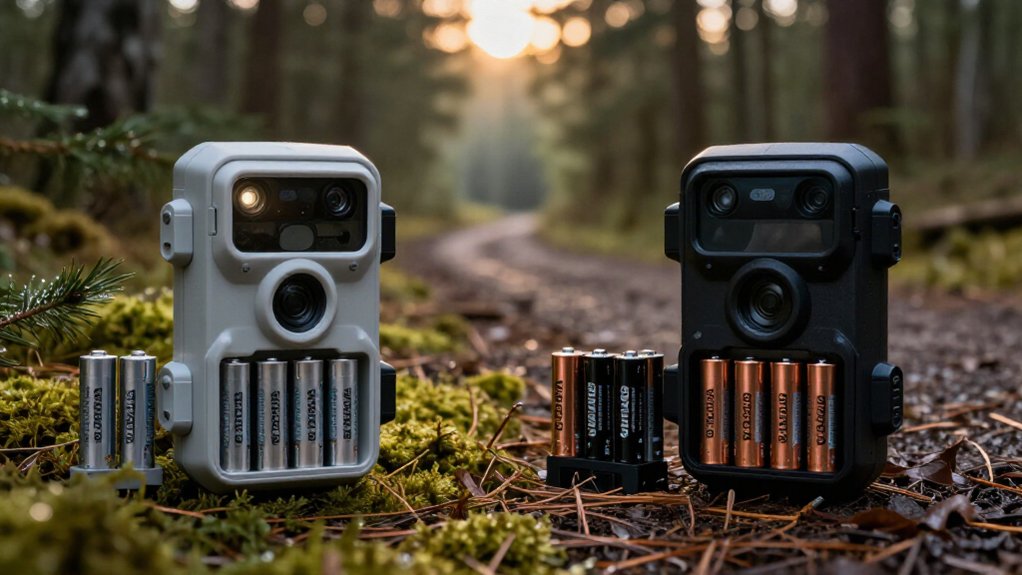
Replace all cells at the same time. Don’t combine fresh batteries with partly used ones, even within one chemistry, because unequal charge levels can create inconsistent output. For each deployment, use a complete set with the same chemistry, brand, and similar age. If you switch, check manufacturer compatibility guidance and install a matching set.
Conclusion
You’ll get the longest service life from lithium AA cells, especially when your trail camera faces -20°F, frequent infrared flashes, or months between checks. Their 20-year shelf life, flatter discharge curve, lower leak risk, and faster swap-and-go reliability offset higher upfront cost. Alkalines cost less initially and suit mild-weather, high-turnover deployments, but voltage sag and cold-weather losses shorten usable runtime. Use only manufacturer-approved cells, replace sets, and never mix chemistries or old and new batteries.