Moultrie vs Spypoint: Which Cellular Trail Camera Brand Wins in the Field?
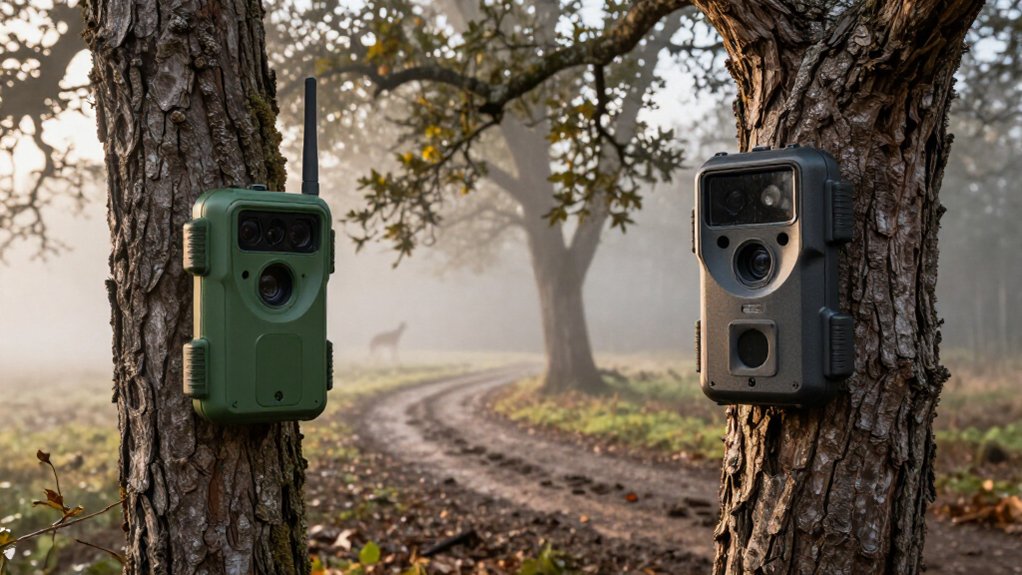
Moultrie wins when you manage larger, remote properties: its Edge 4 Solar line reduces battery-service trips, and Edge 4 Pro Solar’s IP67 sealing stayed dry through torrential rain and hail.
You also get cleaner event feeds, OnX pinning, and reliable LTE delivery after proper activation.
Choose SpyPoint’s $79.99 Flex-M2 for budget setups; its 0.4-second trigger and 90-foot range suit smaller parcels.
Your terrain, maintenance tolerance, and plan needs decide.
The comparisons ahead clarify each tradeoff.
SpyPoint Flex-M2 Value Edge
For budget-focused cellular coverage, the SpyPoint Flex-M2 delivers the core features most hunters need without the price jump of premium models. At about $79.99, you get a practical cellular camera that suits budget-conscious single-camera sets or expanding camera networks.
| Metric | Flex-M2 specification | Field implication |
|---|---|---|
| Trigger speed | 0.4-second | Captures fast-moving deer |
| Detection range | 90-foot stated | Covers typical trail approaches |
| Power | 8 AA or LIT-22 pack | Monitor battery behavior |
The $129.99 two-camera deal, backed by two-year warranty, strengthens the value case when you need several positions covered. In field-style use, its 0.4-second response and 90-foot detection envelope give you capable coverage at a restrained buy-in.
You should, however, factor in battery-life behavior: it can trail some competitors, especially where conditions or camera traffic increase power demand.
LTE Photo Delivery and Activation
LTE photo delivery is only useful when a camera activates cleanly and keeps sending through real field conditions. With the Moultrie Edge 4 Solar, you get reliable transmission, and testing reported no false captures when nothing was present. Its instant OnX pin marks your setup location immediately.
For weather-exposed sites, the Edge 4 Pro Solar family uses IP67-rated sealing; testing found no internal moisture after torrential rain and hail, conditions that can interrupt cellular sends. Moultrie’s Buck Shot can send a zoomed, maximum-resolution image of a mature buck rather than only a wide frame.
The $79.99 Flex-M2 offers budget cellular access, while a $129.99 pair lowers cost. You can receive daily 1080p video with solid audio on your phone, but its battery-life concern remains.
Trigger Speed and Detection Range
Trigger speed determines whether a camera catches a deer entering the frame, while detection range determines how early it wakes and records. For a budget cellular baseline, the SpyPoint Flex-M2’s 0.4-second trigger and 90-foot detection range provide usable coverage on trails and feeder approaches. You’ll get more reliable results when deer cross the sensor zone rather than skim its outer edge.
Moultrie’s Edge 4 Pro Solar stood out in field reporting because it didn’t trigger when nothing was present, a practical advantage where wind, heat, or moving vegetation can waste transmissions. For range context, leading cameras reach farther: Browning testing recorded daytime captures from roughly 10 to 120 feet and night detection beyond 100. Tactacam’s Reveal Pro 4.0 led on open food plots and terrain.
No-Tools Mounting and Alignment
Once you’ve chosen a productive sensor zone, you need a camera that mounts and aims quickly without repeated trips back to the tree. Moultrie’s Edge 4 Solar starts with an immediate pinned setup through OnX, so you can establish placement before securing the strap. Its IP67 rating also gives you more confidence leaving the camera exposed while you verify angle and height in rain or dust.
SpyPoint’s Flex-M2 supports a similarly straightforward routine: mount it, confirm its daily 1080p video and audio output, then make any needed correction. If you want fewer return adjustments, Edge 4 Pro Solar’s avoidance of “nothing-there” triggers can help reveal whether your aim covers an active lane rather than empty background. Fast feedback aids alignment; .25-second triggers show why.
Multi-Carrier Coverage for Remote Properties
On remote acreage with uneven service, a multi-carrier cellular camera gives you the best chance of maintaining daily image or video delivery instead of losing contact in a single network’s dead zone. You can test camera at the stand, not at the gate, because ridge lines, timber, and draws change signal over short distances.
SpyPoint’s Flex-M2 offers a budget-minded route to multi-carrier connectivity while retaining a 90-foot detection range and 0.4-second trigger speed. Moultrie’s Edge 4 Pro Solar emphasizes reliable triggering, with no reported false triggers in use, so fluctuating coverage doesn’t waste uploads on empty frames. Edge 4 models also pair with OnX for deployment pins. That mapping helps you compare locations, move cameras toward stronger service, and document where each carrier delivers.
Battery Costs and Solar Upkeep
Although SpyPoint’s Flex-M2 costs less upfront at $79.99, its 8 AA batteries and included LIT-22 power pack require periodic replacement, which can erase savings on cameras that transmit frequently. If you place cameras far from access roads, replacements add service trips, fuel, and downtime. Flex-M2 battery-life concerns mean your expense depends on weather, signal conditions, and transmission frequency.
Moultrie’s Edge 4 Solar uses solar support to maintain power and reduce battery-change intervals. Its IP67 housing has endured torrential rain and hail, supporting deployment. You’ll need to keep its panel exposed and clear of debris, but inspection costs less than AA replacements.
That advantage grows when you run multiple cameras across distant properties, provided each panel receives adequate sunlight and you inspect mounting hardware regularly.
Monthly Photo Plan Caps
Power is only half the operating-cost equation; monthly photo-plan caps determine whether your camera can keep sending useful detections during peak activity. The $79.99 Spypoint Flex-M2 can maintain solid detection performance, yet its plan limit may reduce uploads after you exhaust the allowance.
Compare each plan by more than image count: high-resolution photos, longer video clips, and frequent alerts consume data at different rates across Moultrie and Spypoint models, including the Moultrie Edge 4 Solar. Higher-quality settings accelerate consumption; a 50MP transmission option, such as the Stealth Cam Deceptor Max 3.0’s, illustrates the tradeoff.
Before the rut, set sensible resolution, limit video length, and add delay between triggers. You’ll preserve transmissions for fresh movement rather than unnecessarily burn the cap on repeated, low-value detections.
AI-Powered Species Recognition
You’ll get better species identification when your camera captures sharp, consistently transmitted images with few false or missed triggers. Moultrie Edge 4 Solar supports dependable AI filtering through reliable detection, while SpyPoint Flex-M2 adds app-based recognition at a $79.99 entry price.
Use smart species filters to reduce review time, but verify labels when poor lighting, motion blur, or weak app categorization affects accuracy.
Species Identification Accuracy
AI species recognition depends first on the quality of the image the camera captures and delivers. In field use, both the Moultrie Edge 4 Solar and SpyPoint Flex-M2 provide the capture consistency needed for dependable classification when deer, turkeys, or other animals pass within effective range.
Moultrie’s consistent triggering is an advantage: testers reported no false triggers with nothing present, so the recognition system receives fewer empty frames. Its OnX-assisted placement and rapid pinning also help you place cameras where activity and location context are meaningful. However, when you operate several units, Edge app categorization can lag behind the hardware’s performance.
SpyPoint’s Flex-M2 supports identification with steady cellular delivery, clear 1080p video, and reliable daily phone updates. That reduces missed, poorly documented encounters overall.
Smart Filtering Features
Smart filtering matters most when a camera sorts likely species events before upload, cutting the empty or irrelevant images you’d otherwise review. In field use, your best results depend on dependable detection and responsive app organization.
- Moultrie Edge 4 Pro Solar avoided needless “nothing was there” triggers, keeping filtered feeds centered on probable target activity.
- SpyPoint Flex-M2 delivered consistent daily 1080p photo and video uploads with solid audio, giving its filters dependable events to process.
- Moultrie’s OnX integration lets you pin recognized-event locations immediately, helping you connect species records to terrain context.
- Watch app performance: Edge 4 Solar categories can lag when you manage multiple cameras.
Choose Moultrie when you value cleaner event capture and mapping workflow. Choose SpyPoint for reliable budget uploads daily.
On-Demand Photo Requests
On-demand requests let you pull a fresh image without waiting for the next scheduled upload, so request speed and delivery reliability matter in the field. Moultrie’s Edge 4 Pro Solar reliably returned zoomed, maximum-resolution photos, while the SpyPoint Flex-M2 delivered crisp images and 1080p video with usable audio to your phone.
You’ll also need to weigh app controls: Moultrie’s Strike Force Wireless app can struggle to categorize photos when you manage multiple cameras.
Request Speed And Reliability
When you request photos from the field, Moultrie’s Edge 4 Pro Solar responds with dependable triggers and fast OnX pinning, without the “false nothing” reports that can waste a check-in.
Field-tested results separate request reliability from other camera traits:
- Moultrie’s Edge 4 Pro Solar returned requested images reliably, then mapped camera location quickly through OnX.
- Its IP67 housing endured torrential rain and hail, reducing moisture-related interruptions during field checks.
- Spypoint’s Flex-M2 delivered crisp photos, 1080p video, and usable audio to your phone consistently each day.
- Flex-M2’s observed weakness involved battery performance, not cellular delivery, so request stability remained solid.
If you prioritize location confirmation and weather-resilient requests, Moultrie takes the edge. Choose Spypoint when dependable daily multimedia delivery matters most.
App Controls And Limits
Reliable cellular delivery only helps if the app makes camera checks efficient. With Moultrie, you can use app integration, including the OnX partnership, to pin an Edge 4 immediately after placement. That location control matters when you’re managing a dispersed setup and deciding which unit needs an on-demand request.
The Edge 4 Solar’s reported lack of false triggers also reduces needless checks, while its IP67 housing kept operating through torrential rain and hail. Spypoint’s $79.99 Flex-M2 gives you simpler access to core cellular controls and supports frequent on-demand viewing without added setup.
However, if you run multiple cameras, Moultrie’s Strike Force Wireless app may lag behind the hardware when categorizing photos. This limitation can slow how you sort requests across a larger camera network.
Image Delivery Quality
Image requests reveal the practical difference between the brands: Moultrie’s Edge 4 Pro Solar reliably returns crisp, high-resolution photos, including Buck Shot zooms that make mature-buck identification easier without a site visit.
- Moultrie: You’ll get the clearest requested stills and useful buck-identification framing.
- Spypoint: Flex-M2 reliably transfers high-quality 1080p video with good audio to your phone daily.
- Consistency: Both platforms handle cellular delivery well once you’ve prompted them.
- Power: Repeated requests can raise draw; Flex-M2’s battery concern matters in remote setups.
In field testing, Edge 4 units pinned instantly through the OnX partnership, so your request connected quickly and returned targeted detail without false triggers when nothing was present. If you prioritize immediate photo clarity, Moultrie leads; Spypoint remains dependable for scheduled multimedia transfers daily too.
Property Size Determines Winner
Property size can outweigh brand loyalty because detection range, placement options, and maintenance demands change as acreage expands. On smaller parcels, the $79.99 SpyPoint Flex-M2’s 90-foot detection range and 0.4-second trigger give you dependable daily cellular coverage without forcing a premium purchase.
As target distances grow across food plots or open terrain, you need stronger long-range performance; the Tactacam Reveal Pro 4.0 has excelled in detection-range testing and suits these sets better. For broad acreage, Moultrie’s Edge 4 Solar becomes the practical Moultrie choice. Its IP67 housing handles rough weather, reliable triggering expands placement options, and solar power cuts battery-change trips. If long-range cellular coverage beyond typical distances matters most, favor cameras with proven 100-plus-foot detection results rather than selecting strictly by badge alone.
Conclusion
Choose SpyPoint’s Flex-M2 when you need lower entry cost, straightforward activation, no-tools setup, and multi-carrier reach across difficult terrain. Its photo plans, AI species filtering, and on-demand requests give you practical control, but monthly caps can limit heavy use.
Choose Moultrie when your property demands broader ecosystem integration or its plan structure better matches your image volume. You’ll get the best result by matching carrier signal, detection needs, and expected monthly transmissions to your acreage.
Solar Trail Camera Battery & Panel Sizer
Estimate how long a trail camera battery lasts and the minimum solar panel watts it needs, from your own battery, current draw and sun-hour figures.
Cellular Trail Camera True Cost Calculator
Add plan fees, overage and activation to the camera price to see the true total cost, cost per camera-year and break-even of a cellular trail camera.