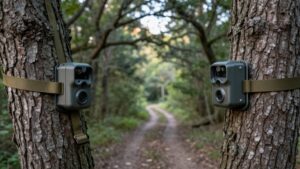
What Does No Glow Mean on a Trail Camera? 940nm IR Explained
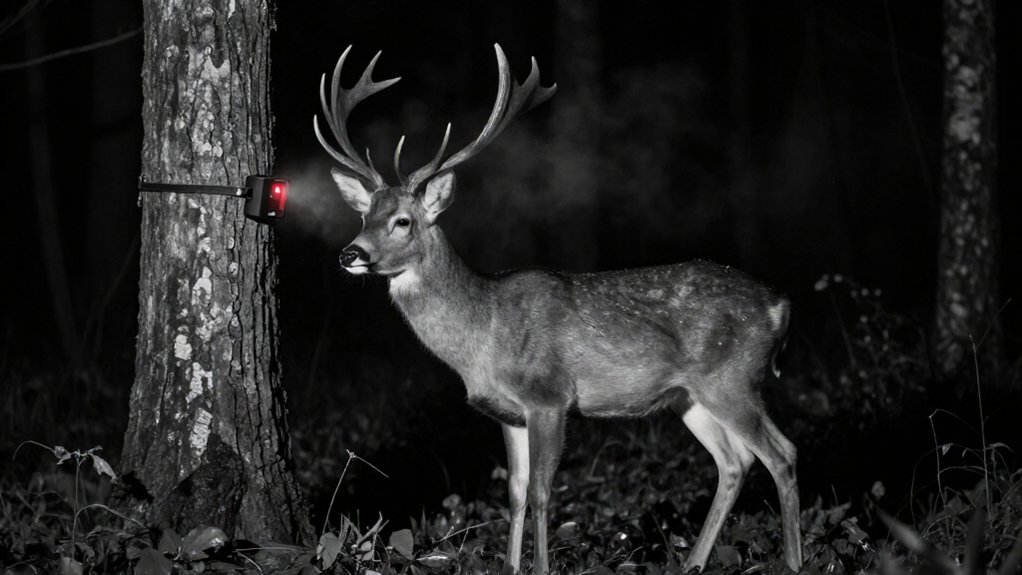
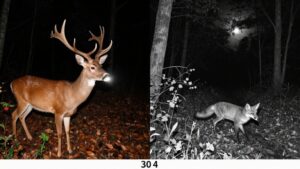
No-glow on a trail camera means you use 940nm infrared LEDs for night illumination. Your eyes typically can’t see this wavelength, so the LED array doesn’t show the faint red glow produced by 850nm low-glow cameras.
The sensor records reflected infrared as black-and-white images or video.
You trade some brightness and practical range for discretion, and moving animals can still blur in dim conditions.
Camera placement, moonlight, and sensor quality shape results. Continue for trade-offs.
940nm IR Is Invisible
No-glow trail cameras use 940nm infrared LEDs to illuminate nighttime scenes without producing visible light. At this wavelength, the illumination falls outside the range your eyes can see, yet the camera’s image sensor remains responsive to it. When the camera detects motion or begins a scheduled capture, its LEDs project infrared energy across the scene.
The sensor records reflected infrared light and converts that information into a monochrome photo or video image. This process lets you document activity after dark without adding visible illumination to the area. You should still treat “no glow” as a description of the LEDs’ visible output, not a guarantee of undetectability. Animals don’t share identical visual sensitivity, so some species may notice the camera itself, its sounds, or cues.
940nm LEDs Avoid Red Glow
Most no-glow trail cameras use 940nm infrared LEDs, which emit light the human eye can’t readily see and therefore avoid the faint red glow associated with 850nm low-glow illuminators. This wavelength shifts the emitter’s output farther beyond visible red light than typical 850nm LEDs. Your camera’s image sensor still detects the reflected 940nm illumination, allowing it to record photos or video after dark.
Because the LEDs produce little visible output, you’ll usually see no obvious red point at the camera during operation. However, no-glow doesn’t mean undetectable: people or animals may notice housing, movement, sounds, or other cues. You should also expect nighttime brightness and fine detail to depend on sensor sensitivity, lens performance, illumination range, exposure control, and image processing, not wavelength alone.
Backyard Security Without Visible Flash
For backyard security, a 940nm no-glow trail camera can record nighttime activity without the faint red flash common to 850nm low-glow models. Its infrared LEDs illuminate the scene for the sensor while minimizing the camera’s visible signature to nearby people. This can make the unit harder for intruders to notice, although no system guarantees invisibility to every person or animal.
For dependable evidence, evaluate sensor quality, trigger speed, usable night-vision range, and weather resistance alongside infrared wavelength. Position the camera to cover likely approach routes and the area you need to monitor. Keep its lens clean and avoid obstructions that degrade detection or image detail. If you need remote access with fewer site visits, choose cellular connectivity and verify signal strength before permanent installation.
850nm Low-Glow Alternative
If you choose an 850nm low-glow camera, its infrared LEDs emit a faint red glow during nighttime capture. You’ll typically get brighter black-and-white images and longer practical range than with 940nm no-glow models. Low glow fits open fields and general wildlife monitoring when detail matters more than maximum discretion.
Visible Red Glow
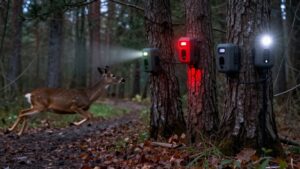
Low-glow trail cameras use 850 nm infrared LEDs, which emit a faint visible red glow while capturing nighttime photos or video. You may notice this glow at the camera’s LED array when it triggers after dark. It isn’t a white flash, but it can reveal the unit’s position at close range. That visibility matters if you monitor locations where people may inspect equipment or where animals react to unfamiliar light sources.
Response isn’t predictable: species, distance, mounting height, vegetation, and ambient conditions all affect detection. Use the comparison below to set expectations.
| What you observe | What it means |
|---|---|
| Faint red LED points | 850 nm illumination is active |
| No obvious red points | 940 nm no-glow design is likely |
Check LEDs during setup before finalizing placement.
Brighter Night Images
When brighter nighttime coverage matters, 850 nm low-glow LEDs generally produce stronger illumination, brighter black-and-white images, and a longer practical range than 940 nm no-glow models. That additional infrared output can expose texture, body contours, antler detail, and background features that may appear subdued under 940 nm illumination. It also helps the camera maintain usable exposure at greater subject distances, reducing the risk that animals become dark, low-contrast shapes near the edge of the frame.
Night-image quality still depends on your camera’s sensor, lens characteristics, exposure control, and image processing, as well as placement, distance, reflective surfaces, weather, and ambient conditions. You should evaluate actual footage rather than assuming wavelength alone determines detail or range. LED power and beam pattern also affect results substantially.
When Low Glow Fits
An 850 nm low-glow trail camera fits situations where you prioritize stronger infrared output, brighter black-and-white night images, and longer practical illumination range over maximum concealment. This wavelength works well when you monitor open fields, food plots, trails, or general wildlife at moderate distances and need clearer nighttime detail. Its LEDs can emit a faint red glow during activation, so don’t use it where animals, people, or security targets may notice the camera.
Low-glow models can also cost less than comparable no-glow units, but price shouldn’t decide the setup. Match the camera to your subject, placement height, expected distance, and stealth requirement. Compare sensor sensitivity, image processing, trigger speed, and rated night range before buying. Wavelength alone doesn’t guarantee better footage; compare overall camera performance.
Moonlight and Sensor Sensitivity
Moonlight adds ambient exposure, but your no-glow camera still relies on 940nm infrared illumination for usable nighttime images. You’ll get brighter, clearer results when the sensor can efficiently detect reflected infrared light, especially at longer subject distances. As moonlight changes, exposure control and image processing must adapt to preserve detail without sacrificing stealth.
Moonlight’s Role in Exposure
Available moonlight gives a trail camera’s sensor some visible light to work with, which can improve nighttime image brightness and preserve detail. You’ll see the greatest benefit under a clear, near-full moon, while clouds and dense canopy reduce the light reaching your target.
| Condition | Light at scene | Exposure result |
|---|---|---|
| Clear full moon | Higher ambient light | Brighter background |
| Partial moon | Moderate ambient light | Some shadow detail |
| Clouds | Reduced ambient light | Darker scene |
| Heavy canopy | Minimal ambient light | IR dominates |
Moonlight doesn’t replace infrared illumination: your 940nm no-glow camera still needs IR LEDs in near-total darkness. Exposure settings and image processing also shape brightness and clarity, so evaluate results across locations rather than crediting moonlight alone. Use test images to refine placement and camera settings.
Sensor Sensitivity After Dark
Beyond ambient moonlight, sensor sensitivity determines how effectively your trail camera records faint reflected infrared after dark. Your camera does not need moonlight when its IR LEDs illuminate the scene; instead, the sensor must convert returned infrared into usable image data. A more sensitive, higher-quality sensor can preserve brightness, contrast, and subject detail from weak reflections.
However, 940nm no-glow LEDs do not inherently deliver better night images than 850nm low-glow LEDs. Overall results also depend on exposure control and in-camera image processing, which govern how the camera balances signal, noise, and motion detail. Keep the lens free of dust, water spots, and smears, because contamination reduces transmitted and captured light. Place it within the illuminator’s effective range to record your subject with adequate definition.
Adapting to Changing Moonlight
Because lunar phase, cloud cover, and nearby terrain constantly alter natural light, you should expect nighttime exposure conditions to vary from one deployment to the next. Moonlight can improve illumination, yet its output changes with phase, clouds, canopy, and terrain. Your camera’s sensor sensitivity and exposure processing determine whether it preserves detail under moonlight.
When natural light is weak or absent, 940nm no-glow LEDs still provide infrared illumination, but wavelength alone won’t guarantee bright, sharp images. Under brighter moonlight, pale rocks, wet vegetation, or direct moon alignment can create uneven exposure or clipped highlights. Test placement at several lunar conditions, then compare cameras by sensor quality, exposure control, and effective IR range. This approach helps you maintain consistent footage throughout seasonal and nightly changes.
Monitoring Owl Nest Boxes
For owl nest boxes, a 940nm no-glow trail camera lets you record nighttime activity with little or no visible red emitter glow, keeping the installation more discreet than an 850nm low-glow model. It doesn’t guarantee an owl won’t notice the camera, but it reduces visible illumination around the entrance. Select a unit whose illumination output and sensor performance provide usable night images consistently.
Because 940nm systems can produce darker footage, test exposure, focus, and image detail before relying on recordings. Mount the camera at a suitable distance and angle to cover the entrance without blocking flight paths. Keep the lens and infrared window clean and unobstructed. Use remote connectivity when available so you can review footage while minimizing visits and disturbance near the box.
940nm Reduces Detection Range
Although 940nm no-glow infrared keeps the emitter less visible, it usually delivers a shorter practical illumination range than 850nm low-glow infrared. Because 850nm LEDs generally produce stronger illumination, your camera receives less reflected infrared from subjects near the outer edge of its field. At longer distances, nighttime images can appear darker or grainier as fewer photons reach the sensor.
Actual results depend on the camera’s sensor sensitivity, exposure programming, lens, LED output, and image processing, so advertised ranges aren’t directly comparable across models. To preserve coat and antler detail, place the camera closer to the animal’s travel route instead of positioning it at the claimed distance. Test its performance at your site: vegetation, backgrounds, weather, and subject angle can reduce the usable 940nm range.
940nm Does Not Stop Blur
A 940nm no-glow infrared system hides the camera’s illumination from most animals and people, but it can’t freeze motion in nighttime photos or video. Blur occurs when an animal moves during exposure, especially when dim conditions force a slower shutter speed. Compared with low-glow units, no-glow models can yield darker, grainier frames and more blur.
- Your sensor’s quality determines how well it records limited infrared light.
- Exposure settings balance brightness against subject sharpness.
- Image processing can reduce noise, but it can’t restore detail lost to movement.
- Mount the camera close to the trail for stronger illumination and usable detail.
You’ll get clearer results by choosing strong low-light hardware and placing it near the animal’s expected route at night, where illumination stays effective more consistently.
Check Local Wildlife Camera Laws
Before you install a no-glow trail camera, check the current wildlife, land-use, and privacy rules for your state, province, and municipality. Regulations can differ across jurisdictions and change seasonally. Confirm whether public-land use is permitted and whether agencies require permits, restrict camera locations, prohibit placement near trails or bait, or impose seasonal closures.
On private land, get the landowner’s permission and comply with trespass and privacy requirements, especially if the device may record people. Review rules specific to cellular or wireless models; image transmission, remote access, and data storage may trigger additional restrictions.
A 940nm infrared flash produces no visible glow, but it doesn’t exempt your camera from wildlife, land-management, recording, or privacy law. You must verify requirements with the responsible agency before deployment.
Conclusion
On a trail camera, no-glow means the unit uses 940 nm infrared LEDs, so you won’t see the faint red emitter glow common with 850 nm models. You gain discreet nighttime monitoring for security or sensitive wildlife sites, including owl nest boxes, but you usually lose some illumination range. Moonlight and sensor performance still control image quality, and 940 nm won’t prevent motion blur. Before deployment, check local laws governing wildlife cameras where you operate.