Cellular Trail Camera Data Plans Compared: Spypoint, Tactacam, Moultrie and More
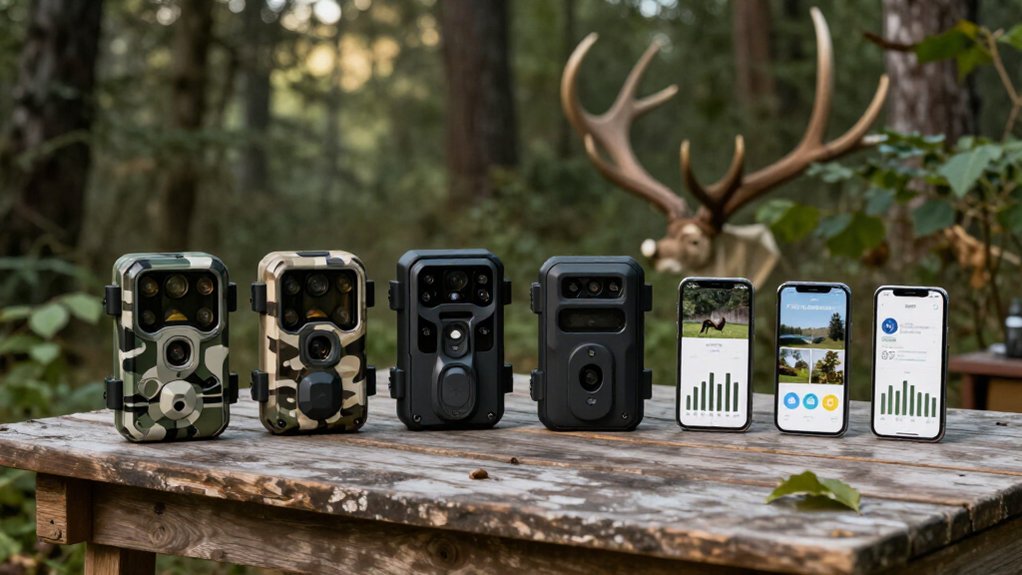
Choose a cellular trail camera plan by comparing renewal cost, sharing rules, and signal at your stand, not just the advertised monthly price. Spypoint pooled allowances can suit uneven camera activity, while Tactacam tiers generally apply per camera. Moultrie starts near $8.99 monthly; paid Spypoint and Tactacam plans start around $5.
Check HD download, video, and over-limit rules: “unlimited” photos may exclude video. Annual billing can lower renewal costs, but check coverage.
Continue for setup comparisons.
Compare Pooled vs. Per-Camera Plans
Pooled plans and per-camera plans handle multi-camera costs very differently. With a pooled option such as GardePro’s all-cameras-under-the-same-plan allowance, every camera draws from one monthly preview-photo pool. You can let a high-activity scrape camera use more data while low-traffic cameras consume little, without matching a separate allowance to each unit.
Per-camera structures, common with Tactacam, assign capacity by camera and generally scale as you add devices. Tactacam’s Intermediate and Pro multi-camera discounts can soften that growth, but they don’t create a truly shared bucket; tier limits still govern each camera, and Starter allows 250 photos. If your cameras produce uneven volumes, total monthly usage, not each camera’s individual ceiling, should guide your choice. Pooling usually reduces wasted capacity and simplifies management across a larger, mixed-activity setup.
2026 Plan Price Snapshot
2026 cellular trail-camera plan prices range from free entry tiers to low-cost unlimited options, so your expected photo volume matters more than the headline monthly rate. Spypoint gives you the lowest starting cost, while Bushnell’s $14.99 unlimited option targets heavier use. Tactacam starts at $5 monthly, and annual billing can cut costs roughly 15 to 20%. Moultrie plans begin near $8.99 monthly. Browning Scout starts at $9.99 after a free first month; Scout Plus costs $12.99. Compare recurring service, not camera purchase price, before you commit.
| Brand | 2026 monthly starting point |
|---|---|
| Spypoint | Free; paid from $5 |
| Tactacam | From $5; annual billing saves 15 to 20% |
| Moultrie | From $8.99 |
| Browning/Bushnell | $9.99/$14.99 unlimited |
Use these snapshots as a baseline; verify checkout terms, since promotions, billing cadence, and availability can change quickly.
Photo Allowances, HD, and Videos
Monthly price tells only part of the story: photo allowances, HD downloads, and video rules determine what you can actually send before a plan limits service or adds charges.
Most plans meter standard photo transmissions, then reserve HD downloads for selected tiers or quantities. Treat video differently: a 10-second clip can use about as much data as 20 standard photos, so stills usually stretch your allowance farther. Don’t assume every cap works alike.
Some brands stop transmissions when you reach the limit; Reconyx Standard can automatically add 2,000-photo blocks instead. “Unlimited” also needs a closer read. Bushnell CelluCore Solar lists unlimited photos but no video, while Bushnell Scout Plus adds defined HD download allowances on higher tiers. Compare expected triggers, HD needs, video use, and overage rules.
Carrier Coverage and Signal Bands
Your camera typically uses the manufacturer’s carrier setup, so compare each plan’s network compatibility and LTE band support rather than relying on your phone’s service. Coverage maps offer a useful baseline, but rural terrain can change available bands within the same county and delay uploads even when the camera records to SD.
A multi-carrier option can improve your odds, but you should test the camera in the exact location before committing to a plan.
Carrier Network Compatibility
Carrier compatibility can determine whether a cellular trail camera sends images promptly or leaves them queued on the SD card, so compare the network and supported signal bands at your exact hunting location, not your phone carrier.
Most cameras use the manufacturer’s SIM and subscription portal, so you generally can’t transfer a Spypoint, Tactacam, or Moultrie plan to another carrier. That lock-in makes local tower coverage the key comparison: a camera may record every trigger yet delay or fail uploads when its assigned network is weak. Verify each brand’s network details and coverage maps, test signal at the stand if possible. Nationwide claims aren’t equivalent to usable service in your valley, timber, or lease.
Solar-powered models don’t alter this calculation; transmission still depends on network connection.
LTE Band Support
LTE band support often separates a camera that reliably sends photos from one that only works near a tower. Your camera’s modem must support the LTE frequencies used by the carrier with the strongest signal at your site. A “nationwide” plan doesn’t change that: manufacturer-run cellular service and photo delivery still depend on compatible bands.
Compare each model’s published band list, not just its brand or plan price. Tactacam and Moultrie solar models can extend runtime and improve placement options, but a REVEAL Pro 4.0 Solar or Edge 4 Solar can’t connect on an unsupported frequency. Check local carrier LTE frequencies before buying, because model revisions may use different modem modules. In marginal areas, that band difference can determine whether photos arrive or not.
Coverage Map Accuracy
Band compatibility explains why carrier coverage maps serve as estimates rather than guarantees. A strong Verizon, AT&T, or multi-carrier map doesn’t prove that your Spypoint, Tactacam, or Moultrie camera will transmit reliably at its mounting point. Cameras use selected LTE frequency bands, while your phone may connect on a different, stronger band; identical phone bars at two sites consequently don’t predict identical camera results.
Treat maps as a filter, not a purchase decision. Check camera-supported bands against the carrier, then test signal at camera height through the app or setup screen. Send preview images from the location and verify delivery speed. GPS-equipped solar models, including the REVEAL Pro 4.0 Solar, improve location tracking, not compatibility. Nationwide claims don’t prevent 110-foot test failures either.
Rural Signal Performance
Rural performance comes down to the network available at the exact camera site, not the plan’s photo allowance or an advertised nationwide footprint. Test your phone at mounting spot; choose carrier with strongest consistent LTE signal. Verizon may outperform AT&T on one ridge, while AT&T wins nearby; town-level coverage means little.
Compare each camera’s supported LTE bands with the bands your preferred carrier uses locally. Compatible bands enable prompt uploads; weak or missing bands often cause failed sends and delays. Tactacam REVEAL Pro 4.0 and Moultrie Edge 4 rely on cellular connection, regardless of solar power or plan tier. Unlimited photos don’t improve transmission reliability. Before buying a Spypoint, Tactacam, or Moultrie model, verify its exact carrier and band support for your specific remote site.
Multi-Carrier Camera Options
If no single carrier delivers dependable service at your camera site, a multi-carrier trail camera can improve upload reliability by connecting through the strongest available partner network. That flexibility can outperform a single-network model when terrain, timber, or distance weakens one carrier. Before buying, compare the camera’s supported LTE bands with coverage maps for your exact region; compatibility, not a nationwide label, determines whether it connects.
Spartan and some third-party setups may accept standard carrier SIMs; most brands require plans sold through their own portals. Nationwide usually means partner-network access, not your phone plan. Test signal at the mount site, especially under canopy; switching can’t create missing bands. Check it at different times before committing to a subscription or deployment plan.
Calculate Annual Renewal Costs
Annual renewal cost starts with the billing method, not just the advertised monthly rate: multiply month-to-month pricing by 12, then compare that total with each provider’s annual option.
Spypoint’s $60/year annual tier costs $60 at renewal, rather than treating it as $5 monthly. For Tactacam, calculate 12 times the monthly tier first, then use its annual price; annual billing typically cuts roughly 15 to 20%. Compare GardePro’s Basic, Standard, and Premium annual totals alongside their roughly 60 to 180-minute Live Stream renewal bonuses.
If you operate several cameras, count GardePro’s same-type shared data pool as one account renewal. Finally, “unlimited” photo plans, including Spypoint Premium and Bushnell CelluCore Solar, can restrict video or features, so verify what your annual payment actually covers before you renew for the season.
SIM Lock and Roaming Limits
SIM compatibility can matter as much as plan price: most cellular trail cameras use a manufacturer-managed SIM or eSIM that works only through that brand’s app and data plans, not your existing phone account.
That setup makes many Spypoint, Tactacam, Moultrie, and similar cameras effectively SIM-locked: you can’t move the camera onto your normal phone plan. A nationwide claim describes the brand’s carrier arrangement, not unlimited compatibility everywhere. Before you buy, check supported coverage where you’ll place it and read the plan’s limit policy. Outside supported roaming areas, your camera may stop sending photos or transmit less reliably. At data limits, the provider may halt sends or charge overages, even with usable signal.
Spartan models can accept a carrier SIM, but roaming rules still apply.
Four-Camera Deer Lease Setup
For a four-camera deer lease, compare plans by total monthly photo volume, not just each camera’s sticker price, because high-traffic funnels can consume far more data than bedding-area sets. Estimate photos by location, then add them before choosing a tier. A shared GardePro pool can simplify budgeting, but every camera draws from the same allowance. Tactacam’s multi-camera savings begin only on Intermediate and Pro; Starter caps you at 250 photos. Spypoint’s 100-photo free plan rarely covers four active sets, while its roughly $5, 1,000-photo Standard tier may work for lighter traffic.
If every camera runs hot, GardePro’s unlimited Gold-style option costs $12 monthly or $120 yearly, with recognition tools. Keep cameras in photo mode: one 10-second video can use data comparable to about 20 standard photos.
APN Errors and Failed Uploads
Even a well-sized multi-camera plan won’t send photos if the camera can’t route data correctly. An incorrect APN can let it register on a carrier while blocking delivery to the manufacturer’s server. Before blaming coverage, compare these symptoms:
- Photos remain on the SD card, but the app receives nothing: confirm your plan is active and linked to that camera’s SIM.
- Uploads stop near your allowance: a 10-second video may consume data comparable to 20 photos, exhausting quotas faster.
- Limits trigger a predictable response: some tiers halt transmissions, whereas Reconyx can add 2,000-photo overage blocks automatically.
Use the manufacturer’s subscription and APN, not a standard phone-line configuration. Repeated failures that match neither limit behavior nor account status usually point to APN settings that need correction immediately.
Verify Activation Fee Terms
Before you activate a cellular trail camera, separate the plan’s recurring data price from any one-time start fee. Spypoint, Tactacam, Moultrie, and other brands may charge differently, so compare the full first-month cost, not just monthly data allowance. A free tier, such as Spypoint’s 100-photo-per-month option, doesn’t automatically mean activation is free.
- Check whether the fee is charged at checkout or when you activate the camera.
- Confirm whether it’s assessed per camera or per account; multiple units can multiply upfront costs.
- Read annual-plan and promotion terms for waived or discounted setup fees.
Also review refund language. An activation fee may be nonrefundable if you return a camera after setup. Record the fee, billing date, trial status, and cancellation rules before entering payment details online.
Conclusion
You’ll save the most when you match your camera count, image volume, and coverage needs to the plan structure. Pooled plans typically stretch farther across a four-camera lease, while per-camera plans can work if one location produces most photos.
Compare annual renewal totals, activation fees, HD/video limits, carrier bands, and roaming rules before buying. Test signal and APN settings early, because a cheap plan loses value when uploads fail. Choose flexible data, not merely price.
Solar Trail Camera Battery & Panel Sizer
Estimate how long a trail camera battery lasts and the minimum solar panel watts it needs, from your own battery, current draw and sun-hour figures.
Cellular Trail Camera True Cost Calculator
Add plan fees, overage and activation to the camera price to see the true total cost, cost per camera-year and break-even of a cellular trail camera.