Can Trail Cameras Use Rechargeable Batteries? NiMH Voltage Problems Explained
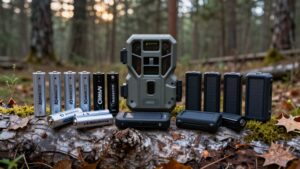
You can use rechargeable AAs in a trail camera, but standard NiMH cells supply about 1.2V each rather than the 1.5V many cameras expect. That reduced headroom can cause low-voltage cutoffs, missed triggers, or night shutdowns when IR flash creates a current surge.
Cold weather worsens sag and shortens runtime.
Use matched cells only, test the camera for 24 hours, and consider regulated 1.5V lithium-ion AAs for steadier voltage.
The details below show verify compatibility.
Many Cameras Require 1.5V
Voltage compatibility is the central issue: many trail cameras are engineered for 1.5V AA cells, so an eight-cell pack starts near the voltage range the camera expects. You shouldn’t treat the battery compartment as part of the camera’s power-design specification, not as a universal AA interface. Its regulators, battery gauge, low-voltage cutoff, and infrared-flash current reserve are commonly calibrated around the voltage profile of primary cells.
In an eight-cell arrangement, that design may be described as 6V or 12V, depending on wiring and labeling, but the critical factor is the voltage available under load. If the supply falls below the camera’s threshold, it can stop recording, miss triggers, or shut down. Check your model’s manual for approved battery chemistries and minimum-voltage requirements; some manuals explicitly restrict rechargeables.
NiMH Starts at 1.2V
NiMH cells create a lower starting point: a fully charged AA typically supplies about 1.2V, versus roughly 1.5 to 1.6V from the primary cells many trail cameras expect. In a four-cell camera, that difference places the nominal NiMH pack near 4.8V rather than 6V. An eight-cell pack begins near 9.6V rather than 12V. If your camera’s electronics, battery gauge, or low-voltage cutoff were calibrated around primary-cell behavior, the lower baseline reduces usable headroom immediately.
You should evaluate the entire power system, not merely whether the camera turns on. Select high-capacity cells, generally 2,500 mAh or higher, and test the pack under the camera’s normal wake, sensing, and recording cycles. Cold conditions further reduce effective voltage, so a configuration that appears stable indoors may provide substantially less operating margin outdoors in winter.
Night Flash Triggers Shutdown
At night, the IR flash can expose a marginal NiMH pack even when the camera appears to operate normally during the day. Motion detection forces the camera to drive its infrared LEDs instantly, creating a high-current surge. Your cells’ voltage then sags because their 1.2 V nominal discharge level provides less headroom than 1.5 V alkalines or lithium cells.
If that transient pulls the pack below the camera’s low-voltage threshold, often roughly 5 to 6 V for a nominal 6 V system, the camera may restart or shut down. You can see missed triggers, fewer photos, or darker images when flash output collapses. Cold conditions and extreme heat worsen usable voltage and increase resistance, so a pack that works in daylight can fail abruptly during nighttime flash pulses.
1.5V Regulated Lithium-Ion AAs
You can use regulated 1.5V lithium-ion AAs to provide the near-constant voltage your trail camera expects, avoiding the lower nominal voltage of NiMH cells. Their stable output can reduce low-voltage cutoffs and improve trigger reliability, including in cold conditions. You’ll need a compatible regulated-lithium charger, and you should assess runtime by watt-hours rather than the cell’s advertised mAh alone.
Regulated Voltage Output
Regulated 1.5V lithium-ion AA cells use internal electronics to hold their output near the 1.5V level expected by trail cameras, avoiding the lower nominal voltage and early sag that can make standard NiMH cells appear depleted.
Instead, you receive a comparatively flat 1.5V per cell supply for much of the discharge cycle. In a six-cell, 6V camera, this reduces the chance that voltage falls below a roughly 5V low-voltage cutoff and causes premature shutdowns or missed triggers. Regulation doesn’t create capacity; runtime still depends on cell quality, stated capacity, and the current demanded during infrared flash surges. It does, however, keep the pack closer to the input range designed around disposable 1.5V AAs, giving you more consistent operating voltage than standard NiMH cells under load conditions.
Trail Camera Compatibility
Compatibility depends on whether your trail camera accepts the flat 1.5V output and battery-monitoring behavior of regulated lithium-ion AA cells. These cells usually provide the voltage profile cameras designed for alkaline or primary lithium AAs expect, unlike NiMH cells, which often operate near 1.2V under load.
Before you install them, read the manual and manufacturer compatibility notes. Some cameras restrict approved chemistries or explicitly discourage rechargeables. For a four-AA, 6V system, a low-voltage cutoff near 5V can cause startup failures, dark images, or missed triggers when voltage sags. Regulated cells reduce that risk, but their monitoring behavior can still matter. A battery-type menu that recognizes regulated lithium-ion cells is strong evidence that your camera tolerates their output characteristics properly during normal field operation.
Charging And Runtime
Once your camera supports 1.5V regulated lithium-ion AAs, charging method and voltage stability largely determine real-world runtime. Use only the dedicated charger specified for your exact battery pack; an incompatible NiMH charger can reduce capacity or damage its electronics.
Under load, regulated cells hold output closer to 1.5V, unlike NiMH cells that settle near 1.2V and decline further in cold. This stability prevents premature cutoff in cameras that require roughly 5–6V total, while supporting flash output, screen operation, and trigger reliability.
You’ll get especially useful winter performance, since these packs commonly operate near -20°C. Charge them correctly before deployment, and you can expect a practical reusable system rated for 1,000+ recharge cycles, while actual runtime depends on temperature, flash use, trigger frequency, and settings.
Camera Low-Voltage Cutoff Threshold
Your camera’s low-voltage cutoff, often near 5 V in a 6 V system, stops operation before unstable power causes black screens or unreliable captures. It detects pack voltage through internal monitoring, sometimes under load rather than only at idle.
Because NiMH cells run near 1.2 V and sag during IR-flash surges, your pack can cross that threshold sooner than alkaline AAs.
Typical Cutoff Voltage Ranges
Most trail cameras protect stable operation with a low-voltage cutoff near 5 V in a nominal 6 V, four-AA system; when battery voltage falls below that threshold, the camera may shut down or fail to start.
| System | Range | Result |
|---|---|---|
| Four AA | Near 5 V | May stop |
| Eight AA | Model-specific | Cell class matters |
| NiMH | 1.4 to 1.2 V | Reduced margin |
| Cold IR load | Brief sag | Intermittent failure |
Thresholds vary by model. Eight-AA operation depends on whether circuitry expects 1.5 V-class cells rather than 1.2 V-class rechargeables. Fully charged NiMH begins near 1.4 V but quickly settles near 1.2 V. Headroom shrinks. Cold and IR loads erase it. It may appear normal, then blank or restart abruptly during capture. Treat values as representative; manufacturers set different cutoff windows.
Low-Voltage Detection Methods
A trail camera enforces its cutoff through a voltage-monitoring circuit that measures the battery pack, often near a 5 V threshold in four-AA designs. The controller compares pack voltage with a reference, then disables recording, imaging, or startup below its programmed limit. Measurements may occur continuously, at power-up, or during demanding loads.
This matters because infrared LEDs, image capture, and radio transmission create current surges that expose voltage drop absent from an idle reading. You may in turn see a healthy-looking battery indicator followed by short clips, missed triggers, or loss of night capture. The exact response depends on firmware: some cameras warn first while others stop operation immediately. Check the manufacturer’s input-voltage range, since its sensing calibration determines which AA chemistries it accepts reliably.
NiMH Batteries Near Cutoff
NiMH cells can sit uncomfortably close to a trail camera’s low-voltage cutoff: a four-AA camera programmed to stop near 5 V effectively expects about 1.25 V per cell. Fully charged cells may read roughly 1.4 V, but they quickly settle near 1.2 V under load. That normal NiMH discharge behavior leaves little voltage margin, so your camera can declare the pack empty while usable capacity remains. Cold weather and higher current compound the problem by increasing voltage sag.
In an eight-AA system, an IR flash surge can pull pack voltage below its operating threshold, producing missed triggers, recording stoppages, or a black screen. Because voltage-sensing cameras react to momentary dips, runtime becomes less predictable than with steadier 1.5 to 1.7 V primary lithium cells in use.
Time-Lapse Monitoring With NiMH
Time-lapse mode can expose NiMH’s voltage limitations faster than standard motion-triggered operation because every scheduled capture creates a brief high-current surge, particularly when the camera activates its IR LEDs. In 6V 4xAA designs, a cutoff near 5V can occur while cells remain partly charged: NiMH commonly operates near 1.2V per cell and sags under each pulse.
You should expect shorter runs than with alkaline or lithium cells, especially in hot conditions. Use matched, quality 2500-mAh-or-higher cells, install them freshly charged, and schedule frequent top-ups. Their self-discharge begins immediately after charging, averaging about 0.5% capacity per day, so stored charge erodes during long deployments. Verify interval settings before deployment, since more frequent captures multiply surge events and increase likelihood of premature low-battery shutdown in cameras.
Cold Weather Reduces NiMH Capacity
Cold weather sharply reduces the usable capacity of NiMH AA cells, with sub-freezing conditions sometimes cutting effective runtime to roughly half. As temperature drops, internal resistance rises and cell voltage sags sooner under the camera’s load. Your trail camera may consequently reach its low-voltage cutoff, often near 5V for a four-cell pack, before the cells have delivered their rated energy.
NiMH still offers reasonable winter performance and often outperforms alkaline AAs, but its field runtime shrinks noticeably compared with warm conditions. A set that might operate for two to two-and-a-half months after installation can require earlier replacement during winter. Check your camera more frequently in cold deployments, especially where nighttime temperatures remain below freezing, and carry spares to restore operation before missed captures accumulate.
Mixing Battery Chemistries
Mixing NiMH cells with alkaline or single-use lithium AAs creates an uneven battery pack because each chemistry starts at a different voltage and follows a different discharge curve. In four- or eight-cell cameras, one weaker chemistry can reach cutoff first.
- NiMH cells sit near 1.2V nominal; alkalines begin around 1.5 to 1.6V, and lithium primaries near 1.6 to 1.7V.
- A 6V pack may shut down near 5V when only part of the set sags.
- IR LED pulses expose weak cells, reducing flash output and causing missed triggers or black screens.
- Use one chemistry and replace every cell together; don’t combine old and new batteries.
Even if the camera appears functional, mismatched discharge behavior shortens the interval above its safe operating voltage during high-current demand. This reduces reliability substantially.
Run a 24-Hour Backyard Test
After installing a matched set of cells, run a 24-hour backyard test to determine whether your camera can tolerate that chemistry’s real voltage behavior. Load identical-brand, fresh cells, eight NiMH or eight alkaline, and record the camera’s low-voltage cutoff, about 5 V for an 8-AA, 6-V nominal system. Fully charged NiMH begins near 1.4 V per cell, then rapidly approaches 1.2 V, which may fall below the operating threshold.
Over 24 hours, document missed triggers, flashing or restarting screens, and truncated videos, especially during IR illumination, when current surges can create voltage dips. Repeat at room and cool temperatures, then compare results with alkaline or single-use lithium cells. Note IR range and brightness: lower-voltage NiMH may weaken both. Consistent control performance but NiMH faults indicate incompatibility.
Conclusion
NiMH cells can power your trail camera, but you must match their voltage curve to the camera’s cutoff design. Because NiMH cells operate near 1.2 V, your camera may report low battery or shut down during infrared flash peaks, cold nights, or time-lapse operation. Test your model before deployment.
If reliability matters, use regulated 1.5 V lithium-ion AAs or a manufacturer-approved external power system. Never mix chemistries, capacities, or charge states in one battery tray.